This post is admittedly different than usual for me, but the intersection of law and AI is something I have the odd background to think about. Felt like saying something here, and, well, this is my blog.
Almost all the chatter I’ve seen involves General Counsel concern over whether their own lawyers, vendors, and employees are using AI safely. They aren’t yet pricing how AI litigation costs on the other side of the docket will affect them.
In many corporate legal settings, AI is going to be a cost-shifting tool as much as a productivity tool, and I don’t think most legal departments have budgeted for it.
I practiced in post-foreclosure litigation and bankruptcy before moving full-time into technology, and have pursued vexatious-litigant relief. I saw firsthand how much economic value the procedure of law can have apart from the merits, and that experience is why I think the coming AI shift matters.
The AI litigation costs everyone is already talking about
Lawyers are already using AI to draft, summarize, research, and review documents – and are generally focused on things like maintaining client confidentiality and avoiding fake citations. Courts are seeing filings with fake cases and arguments generated by tools the lawyers did not adequately supervise, and are responding with sanctions, local rules, and certification requirements.
I don’t think AI is changing the obligations of the attorney. Sure, the speed may change, or the source of a mistake may change. But the professional obligation remains the same. Whether a bad citation came from a junior associate, a paralegal, a research database, or a chatbot, the attorney who signs the filing still owns the filing.
This is important, but it is not where I think many legal departments are going to feel the next wave of AI exposure.
What happens outside the Bar
Pro se litigants have always occupied a different place in the court system, and for good reason. As a society, we have decided justice and access to the courts should not be locked behind the ability to afford an attorney. Justice, at least as a concept in American jurisprudence, is not supposed to come with a price tag.
So courts read pro se filings generously, give more room to correct defects, and hesitate substantially before cutting off access to the courthouse. The rules still apply, of course. But anyone who has litigated against pro se parties knows the practical reality: courts are often reluctant to punish them the way they would punish attorneys.
Again, for good reason. AI changes the economics of that leniency, however.
A lawyer who uses AI badly faces sanctions, malpractice exposure, disciplinary risk, reputational harm, and client consequences. A pro se litigant using AI to draft pleadings and motions faces a very different risk profile. There is no license to lose, no client to answer to, no malpractice carrier watching, and no firm reputation on the line.
Yes, there is the theoretical backstop of a vexatious-litigant designation or prefiling restrictions. I have been involved in pursuing that kind of relief, however, and I know how hard it is to get. Judges do not enter those orders lightly, nor should they. Restricting someone’s ability to file in court is a serious step, and courts are careful before crossing that line. By the time a court gets there, the other side has already been saddled with the expense of answering numerous frivolous motions or filings, let alone bearing the cost to bring the vexatious-litigant attempt.
That distinction is where AI’s impact shows up, because AI makes it nearly free for a pro se litigant to produce legal-looking work. The system remains rightly cautious about blocking that litigant from filing, but the represented party on the other side still has to pay someone to respond.
Why the process itself has value
In some litigation, the value is not tied to winning. Sometimes the goal is delay, or nuisance, or just forcing the other side to spend money or allocate attention.
In post-foreclosure litigation and bankruptcy, I saw how the process itself could have economic value, especially for self-represented litigants. Delaying a foreclosure or slowing down an eviction could mean another month or two in a home without making payments. When the alternative is losing the place where you live, the incentive structure is not complicated.
With the cost of living where it is today, paying a filing fee to create even a month or two of additional time can be a rational trade. A weak filing, of course, likely still loses. But when it takes time – and money – to address, it’s already done its job.
And, AI didn’t create these incentives. Parties have always used procedure strategically. What is new is AI dramatically lowering the cost of accessing the tactic.
Historically, a pro se litigant still had to figure out what to file, how to caption it, what rule to invoke, what arguments to make, and how to sound close enough to legal that the filing would get traction. Many filings were handwritten, incoherent, incomplete, or obviously defective. Some still worked to create delay, but there was a practical ceiling on volume and sophistication.
AI now blows through that ceiling.
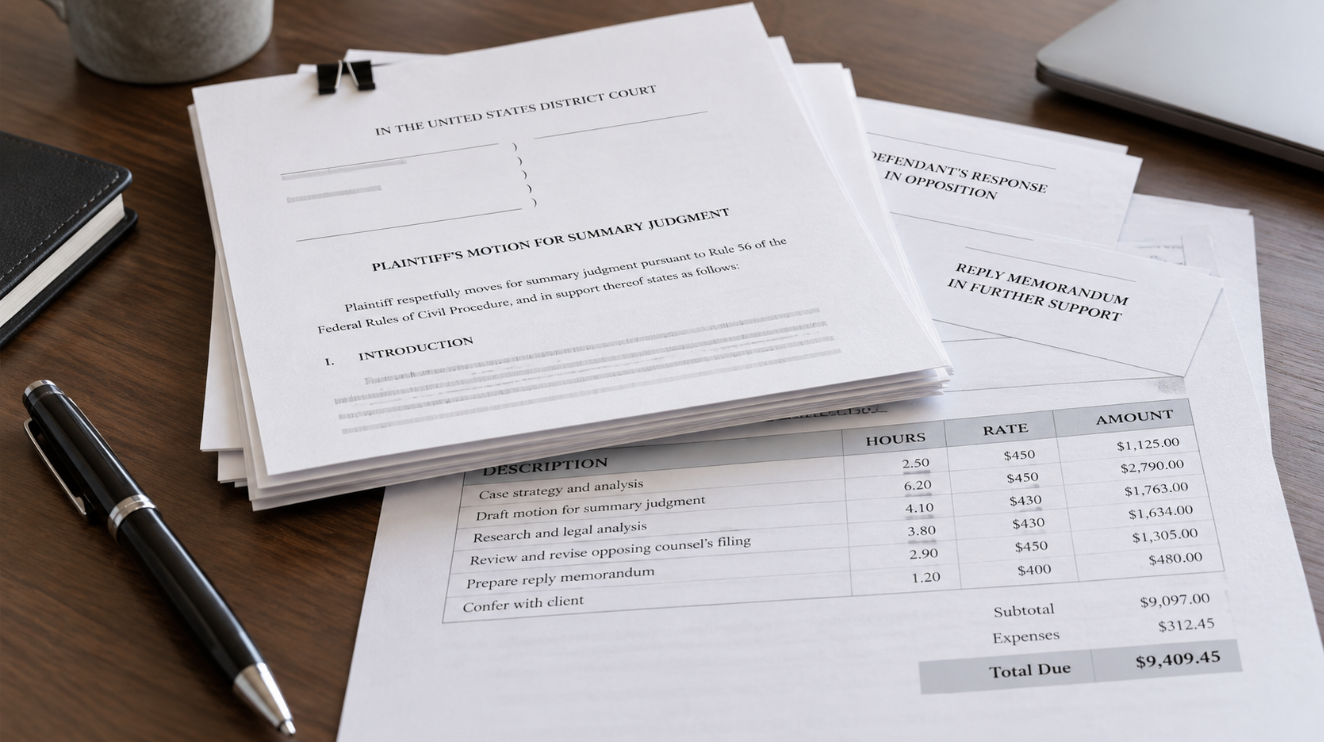
A self-represented litigant can now ask a free or inexpensive AI tool to draft an answer, opposition, motion to compel, motion for reconsideration, emergency request, discovery demand, objection, bankruptcy-related filing, or appellate brief. They can ask for local rule compliance, citations, a more aggressive version, or a response to your motion. They can ask again when the first draft is not good enough.
The output may be wrong. It may hallucinate authority, misunderstand the facts, cite cases that do not exist, or raise arguments with no realistic chance of success.
But, wrong legal work can still create real legal work. Someone has to review it, check the citations, calendar deadlines, and assess the argument. Someone has to decide whether to oppose it, ignore it, move to strike it, seek sanctions, negotiate around it, or let the court handle it.
In high-volume litigation, that someone is often outside counsel. And outside counsel sends a bill.
“But AI helps the defense too”
The obvious pushback is that weak filings are cheap to dispose of, and that your lawyers have AI as well. In many individual matters, that will be true. A short opposition may be all a bad motion deserves, and some filings will still be so defective that they should not consume much time.
The cost shift does not show up only in the single filing, though. It shows up in volume, uncertainty, and accountability.
Mortgage servicers, debt collectors, landlords, insurers, employers, consumer finance companies, and government agencies may face self-represented opponents across hundreds or thousands of matters. A relatively small cost per filing becomes a large cost in the aggregate.
The key is that work is still needed to review and respond to AI-driven filings, because at the time of filing, it is not always clear what you are dealing with. That work isn’t free, and your attorneys can’t just ignore it as a matter of professional responsibility. The issue is who pays for that work.
Asymmetric accountability is the part legal departments will underestimate here. Your lawyer cannot hallucinate back just because a pro se litigant filed an AI-polished but wholly unsupported motion. Your lawyer owns the response in a way the pro se AI user often does not.
So, while AI helps both sides, it does not help both sides equally.
What I expect corporate legal will do
Your litigation spend is likely to rise in matter categories where legal departments regularly face self-represented parties. And, that kind of litigation is where I spent years as an attorney.
Based on my experience, many corporate clients will do what clients usually do when legal spend goes up. They will pressure outside counsel to maintain the status quo, usually by pushing for efficiency, asking firms to “just use AI,” demanding flat fees, or introducing friction to fee approval processes to make it easier to deny bills.
Some of that pressure will be fair, and of course law firms will have to adapt.
But there is danger in pretending that AI hasn’t changed what you and your outside counsel are facing. If legal departments assume AI makes every response nearly free, they may get faster work and cheaper work. They may also drive away the very lawyers they depend on in favor of shops more willing to cut corners, exposing the client to more risk.
The pro se litigant can use AI to create the work. The represented party may expect its lawyer to use AI to make that work disappear. The cost and risk profiles for each side, however, are very different.
Access to justice, and access to delay
Some of the work coming out of AI lowering the effort to generate pleadings will be legitimate. Some people really do need help accessing the courts, and AI may help them explain their situation, identify real issues, and participate in a system that is nearly impossible to navigate without counsel. That is a good outcome.
But AI does not distinguish between access to justice and access to delay. It will help draft both.
Courts will have to sort out which is which, and opposing counsel will still have to respond while that sorting happens. Legal departments will have to pay for the time, or pressure their lawyers to absorb it.
We tend to talk about AI as a productivity tool. In litigation, it may also become a cost-shifting tool, one that allows individuals to impose delay, friction, and legal expense at a scale – and cost – that was previously impractical.
For some litigants, that means better access to justice. For others, it means cheaper access to nuisance value. Either way, the economics are changing.
And from where I sit today as a data and technology leader who has also been an operator, I’d be lying if I said I was not thinking about the problem. The operator in me can see the issue clearly. What I’m less sure of is whether technology can solve it without simply accelerating an arms race.
In some litigation, the other side just wants to purchase delay. AI now makes that nearly free.
–Scott
