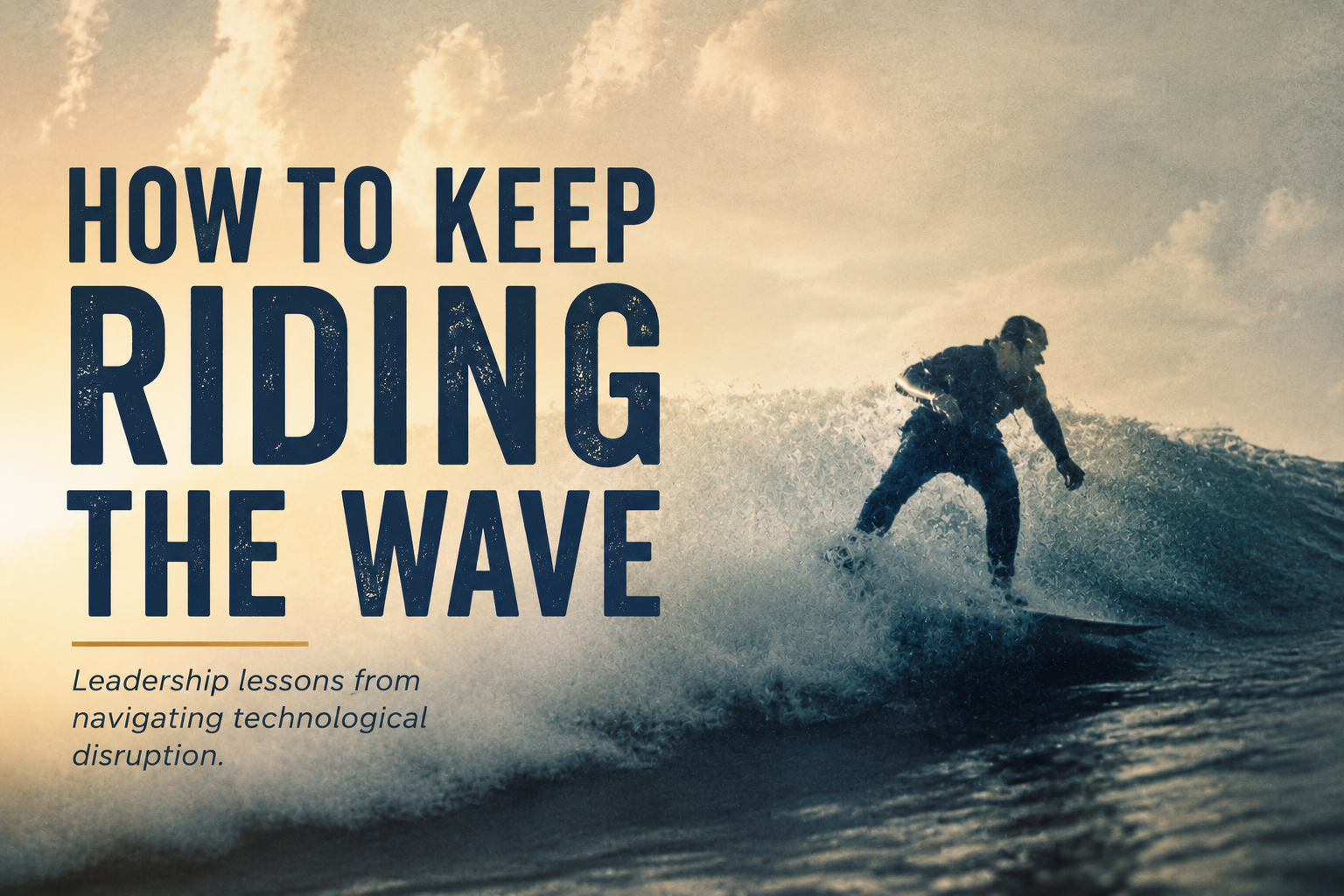
It’s easy to celebrate disruption when it belongs to someone else’s industry.
Record stores gave way to streaming. Newspapers lost readers to the internet. Entire business models faded into history, because progress.
Technological disruption always feels like progress until it’s on your doorstep and knows your name.
I don’t believe that because I studied it. I believe it because I’ve lived it.
My career hasn’t been a straight climb. I’ve had to rebuild it from a reset. It taught me to let go of assumptions about what the next decade would look like and learn to live with uncertainty.
I won’t pretend that was exciting while it was happening. It was painful, and affected those I love. It forced me to become someone I had to learn to get comfortable with, because he’s different than I expected.
That history colors how I look at today’s AI conversation.
I am certain AI will change how organizations operate. I see every major business function already using it every day, which never happened with the last self-anointed change agent (I’m looking right at you, blockchain).
AI will reshape jobs, create new ones, eliminate others, and change expectations in ways none of us can fully predict today.
Yet, none of that feels new or scary to me.
The internet brought uncertainty. So did cloud computing, mobile, virtualization, containers, and DevOps. Every meaningful technology shift I’ve seen forced leaders to make decisions before there was a playbook or any idea what the return on investment might be.
Every one of those shifts taught me the same thing: leaders have to be willing to make decisions with incomplete information, learn quickly, and change course when reality hits.
Technology leadership has never been about waiting for a clean line to paddle into.
If you can see the destination, someone else is already surfing the wave and you’ll be that kook dropping in.
Our responsibility as tech leaders is to evaluate imperfect information, make the best call we can with what we know today, and keep paddling into the wave. Some decisions will be wrong, but being afraid to make one is worse.
The questions haven’t changed nearly as much as the technology has.
How do we govern AI, when everyone assumes deterministic answers from a probabilistic technology?
How do we measure its value, presumably in dollars?
How do we introduce it without creating chaos?
Those answers are still emerging, and they always are at the beginning of any generational change.
The tools will change, as will the platforms. AI won’t be the last tech disruption we navigate, any more than the internet or mobile devices were.
Our job isn’t to predict the future. It’s to help our organizations start paddling today, anyway. Imperfectly, and even with nothing more than educated guesses at times.
Because here’s the thing about technological disruption: it doesn’t arrive on your calendar, it’s messy, and it seems like exciting progress.
Up until it knows your name.
What hard calls are you making today? Are you ready for when the horizon goes dark and you’ve got to paddle for your life? Or are you just hoping to sit on the outside and somehow miss the set of the century?
— Scott (and yeah, that picture is me surfing…)
